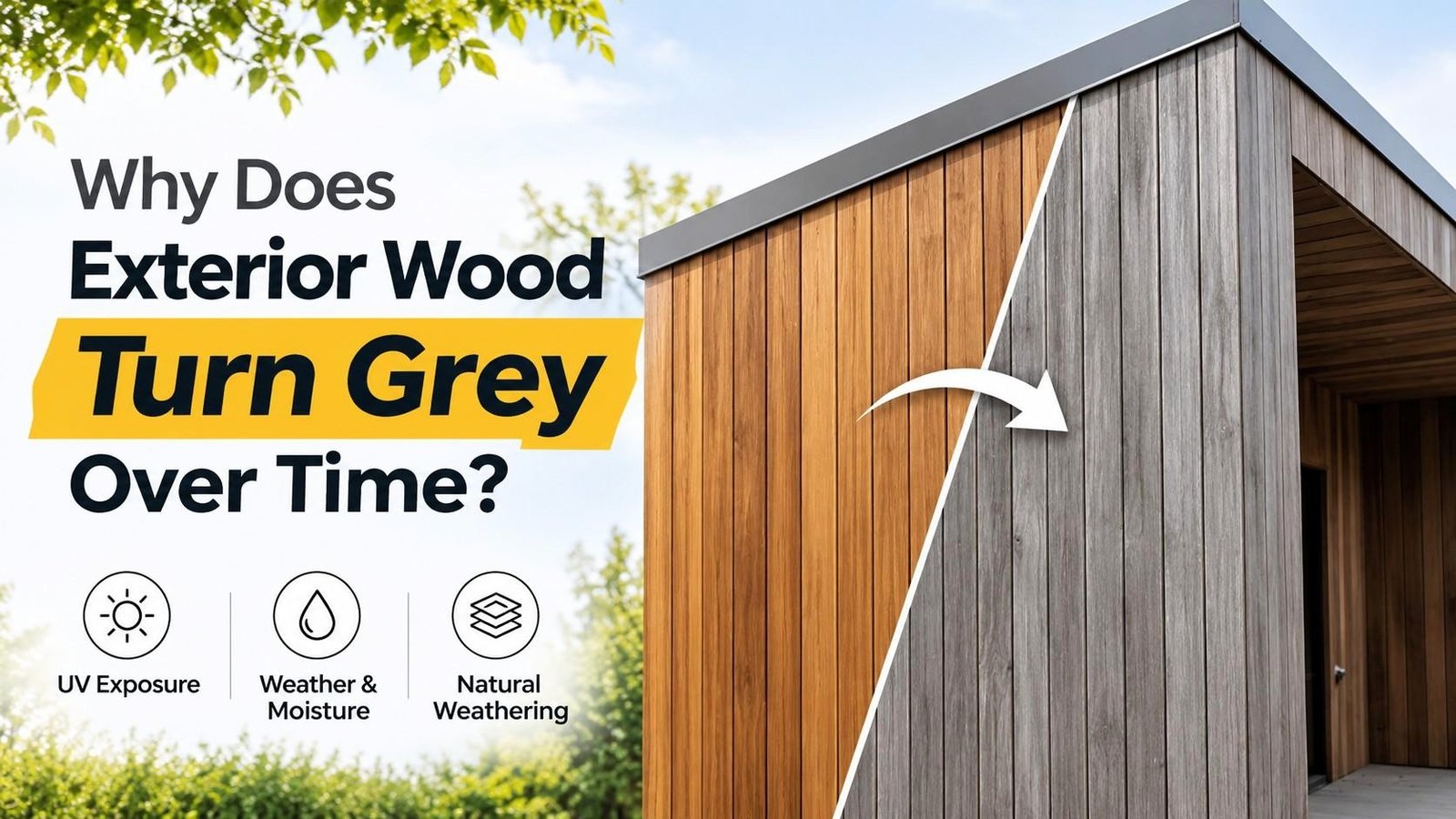
Whenever you install cladding, decking, or fencing for any residential or commercial exterior project, its rich, warm colour gives the entire space a premium look. However, have you ever noticed that wood with a natural brown or golden colour starts to look silver-grey after some time?
The biggest question is whether this grey colour is a sign that the wood is damaged or rotting. Many people become concerned that their expensive wood is deteriorating. However, the reason behind this is usually something else.
When wood is continuously exposed to rain, sunlight, and moisture, gradual changes begin to occur on its surface and in its colour. Research by the USDA Forest Products Laboratory (FPL) shows that this is often a natural surface-weathering process rather than a sign of structural decay.
Over time, the surface of wood can turn grey or silver-grey, which is also called a natural ageing effect or silver-grey patina. So, let us take a closer look at why natural wood turns grey when exposed to sunlight and water, and the scientific reasons behind it.
The Science of Wood Weathering: Why Does Wood Turn Grey?
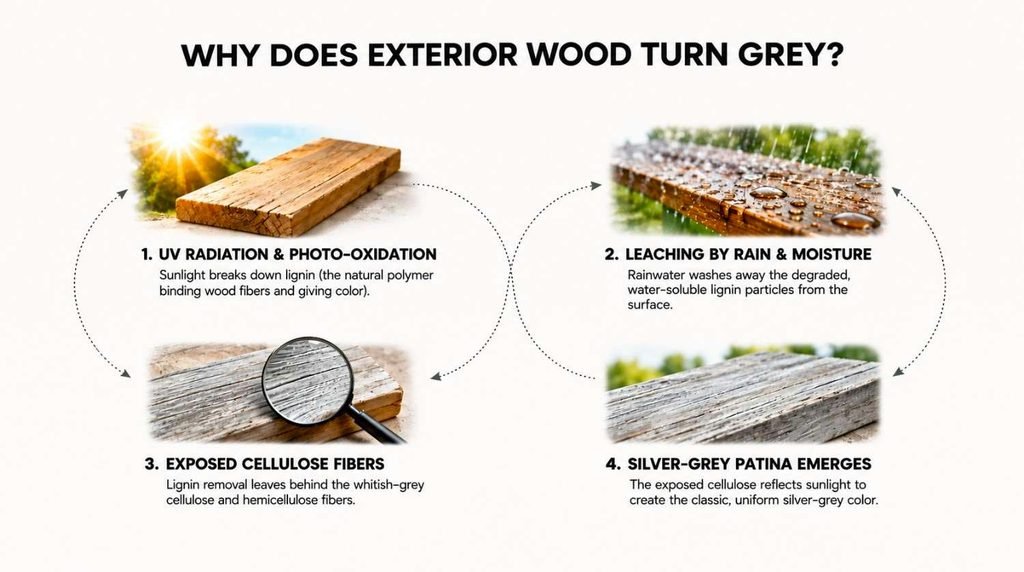
According to wood science research by the USDA Forest Products Laboratory (FPL), the silver-grey or grey colour of wood is the result of a chemical and physical process known as weathering. Three main scientific factors are responsible:
UV Radiation and Photo-Oxidation
When the sun’s UV rays fall directly on the surface of wood, a chemical process called photodegradation begins. During this process, the important component of wood known as lignin begins to break down. Lignin is the natural polymer that binds the cellulose in wood together and contributes to its natural colour. UV rays degrade the lignin, and this process is called photo-oxidation.
Leaching by Rain and Moisture
As the lignin in wood gradually breaks down, rainwater washes away the degraded particles. This washing process is called leaching. When these degraded lignin components are removed, the top layer of the wood gradually begins to lose its original colour.
The Cellulose Factor
As lignin breaks down and is washed away, the surface becomes relatively richer in cellulose and other wood components. This changes the appearance of the outer layer of the wood. Together with continued exposure to sunlight and moisture, these changes contribute to the silver-grey patina that we see.
The speed of this colour change is not the same for every type of wood. Weathering patterns can vary depending on the wood species, sunlight intensity, rain exposure, and climate. Therefore, the greying of exterior wood is not caused by sunlight alone. It results from the combined effects of UV radiation and environmental conditions.
The Role of Moisture, Rainfall and Environmental Exposure
In exterior wood, rainfall itself is not the only factor that matters. How quickly the wood dries after rain is also important. Wood cladding installed on a balcony and cladding directly exposed to rainfall will have different weathering patterns because their moisture exposure and drying times are not the same.
In addition, one of the biggest technical challenges caused by environmental exposure is cyclical wet-dry conditions, meaning the continuous wetting and drying of the wood. When wood absorbs moisture because of atmospheric humidity and rain, and then releases it because of solar exposure, it undergoes continuous dimensional movement. This repeated movement can cause micro-checks or fine surface cracks to develop in the outer layer of the wood. These cracks can provide pathways for water and sunlight to affect the surface further, which can accelerate the weathering process.
The location of the wood is also important. Wood that remains in continuous contact with rainfall, or is located where air circulation is limited, may take longer to dry. In contrast, covered and well-ventilated areas have comparatively less moisture exposure. Another interesting point is that the surface of weathered wood may remain wet for longer after rainfall because its behaviour, surface texture, and water absorption capacity change after weathering. This means that moisture can affect old, weathered wood differently from freshly exposed wood. If these conditions occur repeatedly, the risk of biological growth and moisture-related deterioration may increase. Therefore, understanding the location, ventilation, and drying conditions of exterior wood is important for its long-term maintenance.
Why Does Wood Turn Grey Instead of Just Fading?
When an ordinary object remains in continuous sunlight, its colour gradually fades, leaving only a faded version of its original colour. However, wood does not behave exactly this way. Whether the wood is dark brown, reddish-brown, or golden, its colour can change into a silver-grey patina rather than simply fading. The greying of wood is not just the loss of its original colour.
Outdoor exposure causes chemical and physical changes on the surface of wood, gradually transforming its colour. At first, the wood may appear yellowish, brownish, or faded. With continued weathering, degraded wood components begin to be removed from the surface, leaving behind a comparatively cellulose-rich surface layer. Certain staining fungi that grow on the surface and dust that accumulates there can also influence the grey colour.
Therefore, the final colour of exterior wood is not always uniform. Some surfaces may appear dark grey, while others may look light grey or have uneven patches. These differences may be related to the wood species, environmental exposure, and biological growth on the surface. This natural colour transformation can be called a silver-grey patina, which gives untreated exterior wood an aged, weathered appearance.
Wood Graying vs. Wood Rot: Understanding the Difference
When exterior wood turns grey, there is often a misconception that the wood is damaged or has begun to rot. However, wood greying and wood rot are two different processes. According to wood science research and USDA FPL guidance, wood weathering and wood decay are distinct processes, although they can sometimes occur together.
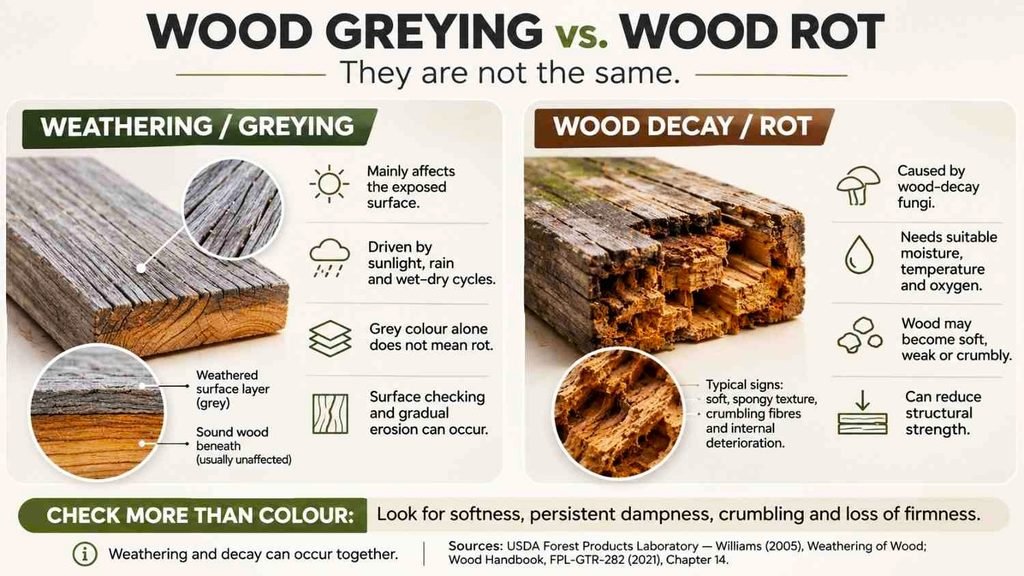
The greying of wood mainly affects its surface and is caused by physical and chemical changes due to environmental exposure. It does not necessarily indicate a problem with the wood’s structural condition. The wood beneath the weathered layer may remain solid, dry, and in good condition. However, prolonged weathering can cause surface erosion and checking, so the overall condition of the wood should not be judged by colour alone.
Wood rot is a biological phenomenon. It develops through the action of decay fungi, which can break down the structural components of wood under suitable moisture conditions. With this type of damage, wood may become soft, spongy, crumbly, or unusually weak. Therefore, instead of relying only on colour, you should also assess the firmness of the surface, persistent dampness, and visible deterioration.
Natural greying and rot can sometimes occur together on the same piece of wood. If exterior wood is becoming soft, shows signs of damage, or raises any concerns, it should be professionally inspected. Greying may indicate a change in appearance, but understanding the wood’s physical condition is essential for determining its actual state.
How Wood Species and Natural Properties Influence Weathering
Every wood species does not behave the same way under outdoor conditions. Some wood species maintain their original colour comparatively well, while others may develop colour changes and surface roughness more quickly. These differences are caused by factors such as wood density, natural chemical composition, grain structure, and environmental exposure. Therefore, simply looking at the colour of the wood is not enough to determine how quickly it will turn grey outdoors.
In a 2021 study comparing 16 wood species, comparatively greater colour changes were observed in pine, maple, and tulipwood, while comparatively less change was observed in walnut, American walnut, and oak. The research samples also showed that colour change was generally less pronounced in higher-density wood. However, this does not mean that every high-density wood species will automatically perform better against weathering, because surface roughness and wood cracking do not depend on density alone.
The natural durability and stability of wood are also different properties. One type of wood may remain structurally durable even after turning grey, while another may deteriorate because of moisture and biological exposure. Therefore, when selecting exterior wood, you should consider not only its species but also the local climate, intended application, protective treatment, and natural durability.
Environmental Factors That Determine the Rate of Greying
The speed at which a silver-grey patina develops on exterior wood depends on various environmental and geographical factors. One of the important factors is geographic orientation, meaning the direction in which the building faces. Walls facing south and west may receive more direct sunlight, causing weathering to occur faster on those walls. In contrast, walls facing north generally receive less direct sunlight and may grey more slowly. However, these areas may retain more moisture, so the environmental conditions are different.
Researchers at the USDA Forest Products Laboratory exposed outdoor wood samples at different angles. In their long-term research, horizontally exposed samples showed greater surface erosion than vertical samples for most of the tested wood species. This shows that the installation angle of wood can also influence weathering because the angle changes the surface’s exposure to sunlight and rain.
The local microclimate and altitude can also affect weathering. If your project is located at a high altitude or in a mountainous region, UV intensity may be greater, which can contribute to the breakdown of lignin. In coastal or high-humidity regions, atmospheric moisture and environmental exposure can increase the overall progression of weathering. Therefore, the environment plays a major role in determining the greying rate of wood.
The Role of Wood Finishes and Protective Treatments in Preventing Greying
If you want to maintain the colour of exterior wood for a longer period, it is important to select a suitable protective finish. Paints, transparent coatings, and stains can be used for exterior wood, but their protection levels are not the same. According to the USDA Forest Products Laboratory, opaque paint systems generally provide strong protection against weathering, while exterior stains can help preserve the appearance of wood and reduce the effects of sunlight and moisture.
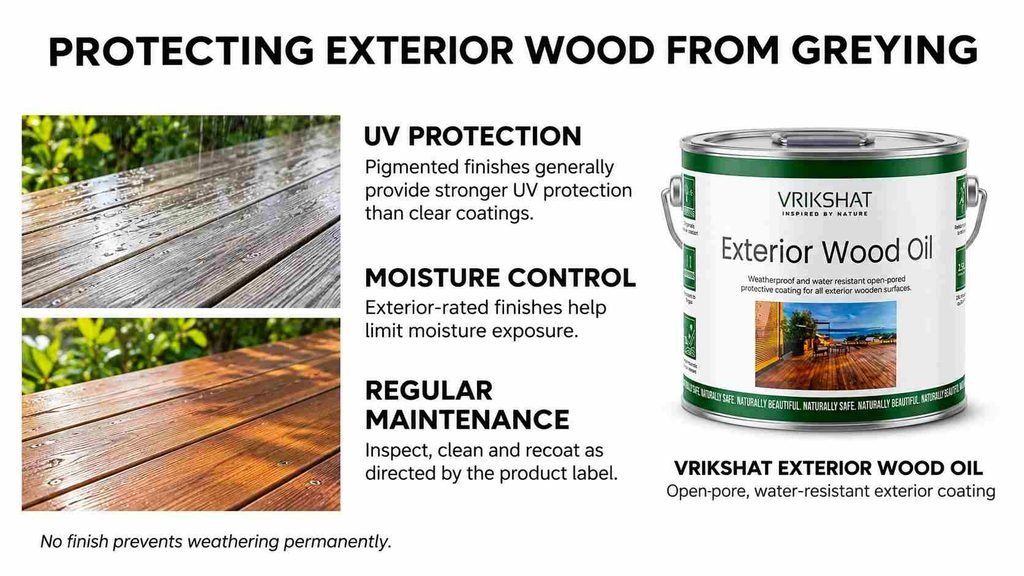
Transparent finishes keep the natural grain of the wood visible, but providing UV protection with a clear coating can be comparatively challenging. Therefore, you should not select a finish based only on labels such as “clear” or “water-resistant.” You should also consider the product’s suitability for exterior use, UV protection, maintenance requirements, and the manufacturer’s application instructions. Research also shows that coating performance can vary according to the wood species, local climate, and environmental conditions.
For maintaining exterior wood, Vrikshat Wood Oil can be considered as an option, provided you select a variant specifically suitable for exterior use. It can help enhance the appearance of the wood and support its maintenance when applied according to the manufacturer’s instructions. However, its ability to protect against UV exposure and moisture depends on the product formulation and should be checked against its technical specifications.
Another important point is that no finish guarantees permanent protection of exterior wood colour. With continuous exposure to sunlight and moisture, coatings can gradually deteriorate, so regular inspections and timely maintenance are essential.
Exterior Wood Maintenance: Preserving Colour and Surface Quality
No matter how well exterior wood is treated, continuous exposure to sunlight and rain means that it still requires regular care. If you want your wood cladding or decking to continue looking attractive, you should follow a simple maintenance routine. The easiest step is regular cleaning. Dust on the wood surface should be removed with a clean cloth or soft brush so that dirt and moisture do not accumulate and create stains.
The wood should also be deep-cleaned once a year. However, you should avoid using high-pressure water and harsh chemicals because they can damage the soft fibres of the wood. Instead, use a mild wood cleaner or gentle soap to remove algae and mould from the surface without damaging the wood. After cleaning, the wood must be allowed to dry completely so that moisture does not become trapped inside. The most important part of maintenance is re-oiling or recoating. As time passes, sunlight and rain gradually reduce the effectiveness of the wood’s protective finish. Depending on the product and environmental exposure, a fresh coat of penetrating oil or stain may be required. The coating should be reapplied according to the manufacturer’s instructions and the condition of the wood surface.
Restoring Weathered Wood: Cleaning, Brightening and Refinishing
If the golden or brown colour of wood has faded to grey or silver-grey, its appearance can be restored to some extent. First, dirt, pollution, algae, and loose weathered fibres can be removed from the wood surface with the help of wood cleaners. Some products also contain wood brighteners, which can help reduce specific stains and discolouration. The appropriate treatment depends on the wood species and the condition of the surface.
After cleaning, the wood should be allowed to dry completely according to the manufacturer’s instructions. If the wood surface has become very rough or the fibres are raised, it should be properly sanded. If you want to maintain the wood’s natural colour, an appropriate protective finish can then be applied for exterior wood use. However, keep in mind that cleaning does not completely restore the original colour in every case, especially when the surface is deeply weathered or damaged.
The purpose of restoration is not only to make the wood brown again but also to bring its surface into a suitable condition. However, if the wood is soft, rotten, or structurally damaged, cleaning or brightening will not restore its strength. In that case, the wood should be repaired or replaced.
Common Misconceptions About Grey Exterior Wood
A common misconception about grey exterior wood is that if the wood has turned grey, it must have rotted. In reality, weathering mainly affects the surface of the wood, while wood rot is primarily related to the breakdown of the wood’s structural components by fungi. Therefore, looking only at the colour of the wood is not enough to determine its condition.
Another misconception is that applying an oil coating to wood will permanently preserve its colour. In reality, protective finishes can slow weathering, but their performance depends on the product, sunlight exposure, and maintenance. Exterior wood must be maintained from time to time according to the manufacturer’s instructions.
Many people also believe that grey wood has already been damaged and must be replaced. However, proper cleaning and maintenance can help restore the appearance of wood, meaning replacement may not always be necessary.
Frequently Asked Questions About Exterior Wood Greying
When wood is used outdoors, the sun’s UV rays break down components inside the wood, especially lignin. Rainwater then washes these degraded components away, causing the wood to gradually appear grey or silver-grey.
It is difficult to stop greying completely, but it can be reduced by using a UV-resistant finish designed for exterior use, performing regular maintenance, and providing proper drainage. It is important to renew the finish according to the manufacturer’s instructions.
The main causes are sunlight, rain, and continuous wet-dry cycles. Dust, surface microorganisms, and surrounding environmental conditions can also affect the final grey appearance of the wood.
Use a wood-compatible cleaner and brightener to clean the surface. If necessary, use light sanding or a suitable wood finish. Always test the product on a small area first and follow the product instructions.
No. Treatment does not permanently stop natural ageing. It slows weathering and colour change. The effectiveness of the protection depends on the type of treatment, UV exposure, and maintenance.
There is no fixed timeline. Wood exposed to significant rain, sunlight, and UV radiation may begin to grey after a few months. Wood located in shaded or protected areas may take considerably longer to turn grey.
Yes. Cleaning, wood brightening, and light sanding can improve the appearance of wood. However, completely restoring the original colour is not guaranteed, especially if the weathering is deep or the wood surface has eroded significantly.
Natural ageing describes the broader changes that occur in wood over time, while weathering describes surface changes caused by sunlight, moisture, and environmental exposure. The greying of exterior wood is a common result of weathering.